
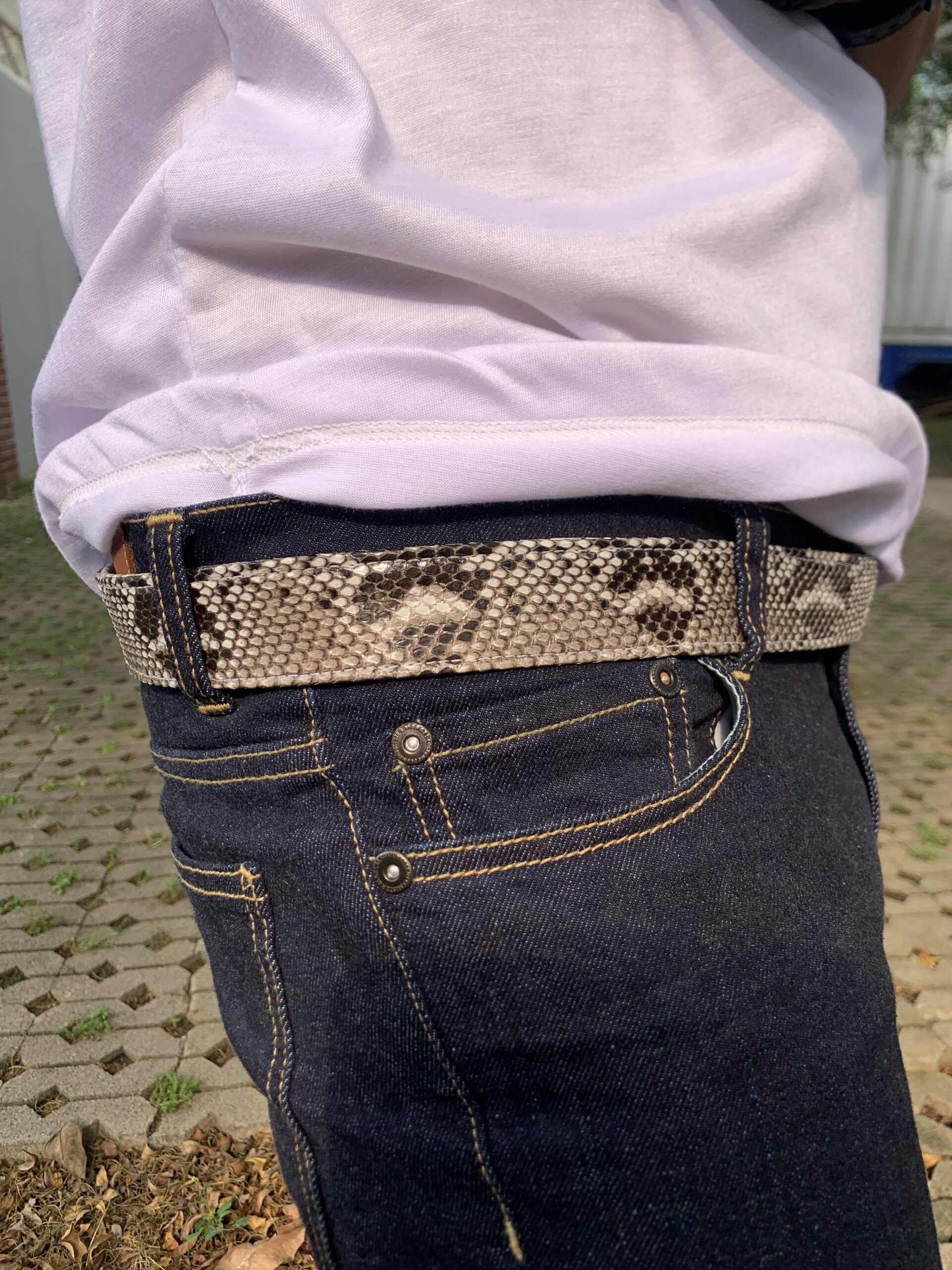
A belt built to be felt, not seen
Most of what I make announces itself a little: a bold scale pattern, a sharp tooth, a carved guardian face. This belt does the opposite on purpose. It sits low, mostly hidden under a shirt, noticed by almost no one at a glance. I wanted that. Python snakeskin rewards a second look rather than demanding a first one, and a belt is exactly the kind of object that should be worn for the person who has it on, not for whoever happens to be watching.
Why python for this piece
A python does not move quickly. It travels as one continuous line, relying on patience and weight rather than speed, and that same unhurried quality carries straight into its skin. Where some scale patterns read as bold and declarative, python reads as a current: it flows rather than interrupts. For a belt, worn daily and mostly out of sight, that quieter character felt right. I was not trying to make a statement piece. I was trying to make something that feels good to put on without ever needing to be seen.
Cutting to keep the rhythm continuous
The hardest part of working with this material is not the cutting itself but the matching. Each panel is selected and aligned by hand so the scale pattern keeps flowing around the belt as one line instead of breaking into visible seams. Get the alignment wrong and the whole piece looks assembled rather than grown. Get it right, and the pattern reads as if it simply continued around the body on its own, the way it once continued around the animal it came from.
Tone and texture vary naturally from one length of skin to the next, and I do not try to correct that. A slightly darker patch or a shift in scale size is not a defect to hide; it is proof the surface was selected rather than printed, and no two finished belts carry the exact same map across their length.
What changes with daily wear
A belt gets more daily handling than almost anything else a person wears: buckled and unbuckled, pulled through loops, bent at the same points week after week. Python skin holds up well under that kind of repetition, and it also changes with it. The surface picks up a little more depth in tone over months of wear, especially at the points where it flexes most, the same way a well-used object anywhere tends to earn a kind of quiet history instead of just showing wear.
Sourced and documented, not just sold
Python skin falls under international wildlife trade regulation, and that is not a detail I treat lightly. Every length of skin used for this belt comes from a regulated supplier, and export documentation is prepared for destinations where it is required. I would rather explain that process clearly upfront than have a buyer discover it as a surprise at customs. A quiet belt should not come with a complicated story attached to it after the fact.
Getting the size right
A belt is one of the few pieces where sizing mistakes are easy to avoid if you measure the right thing. Rather than trusting a trouser size, measure an existing belt you already wear comfortably, from the buckle prong to the hole you actually use, not the one at the very end. That number, not the label inside your waistband, is the one that should guide your choice here. Between two sizes, I generally suggest sizing up slightly, since a belt that sits one hole tighter than ideal is a smaller problem than one that cannot close comfortably at all.
Styling it with the rest of a daily carry
Because this belt is deliberately quiet, it sits easily next to almost anything else in the collection: a structured bifold, a simple keychain, a piece of jewelry with more presence. It is not designed to match a specific piece; it is designed to stay out of the way of whatever else someone has on or is carrying that day. That flexibility is part of the point. A loud accessory limits what it can be paired with. A quiet one rarely does.
Why quiet details like this matter
Every belt here is cut, matched, and finished by hand in my studio in Indonesia, the same exotic leather craft that runs through the rest of the collection. Attic Wild Side sells plenty of pieces built to be noticed immediately. This is not one of them, and I think that is exactly why it belongs in the collection. Not every object needs to compete for attention to be worth making well. Some of the most satisfying pieces are the ones only the person who owns them really knows about.
If you want to understand the material further, our piece on the philosophy of python goes deeper into why this pattern behaves the way it does, or you can browse the complete Attic Wild Side collection for other pieces built the same way.