Built for the hundred times you open it
A wallet does not get judged once. It gets opened at a counter, closed in a pocket, pulled out again twenty minutes later, dozens of times a week for years. Most materials start to look tired under that kind of repetition. Python snakeskin does something stranger: the more it gets handled, the more itself it seems to become. I did not choose this material to look good on day one. I chose it to still look right on day one thousand.
Why the black-grey pattern specifically
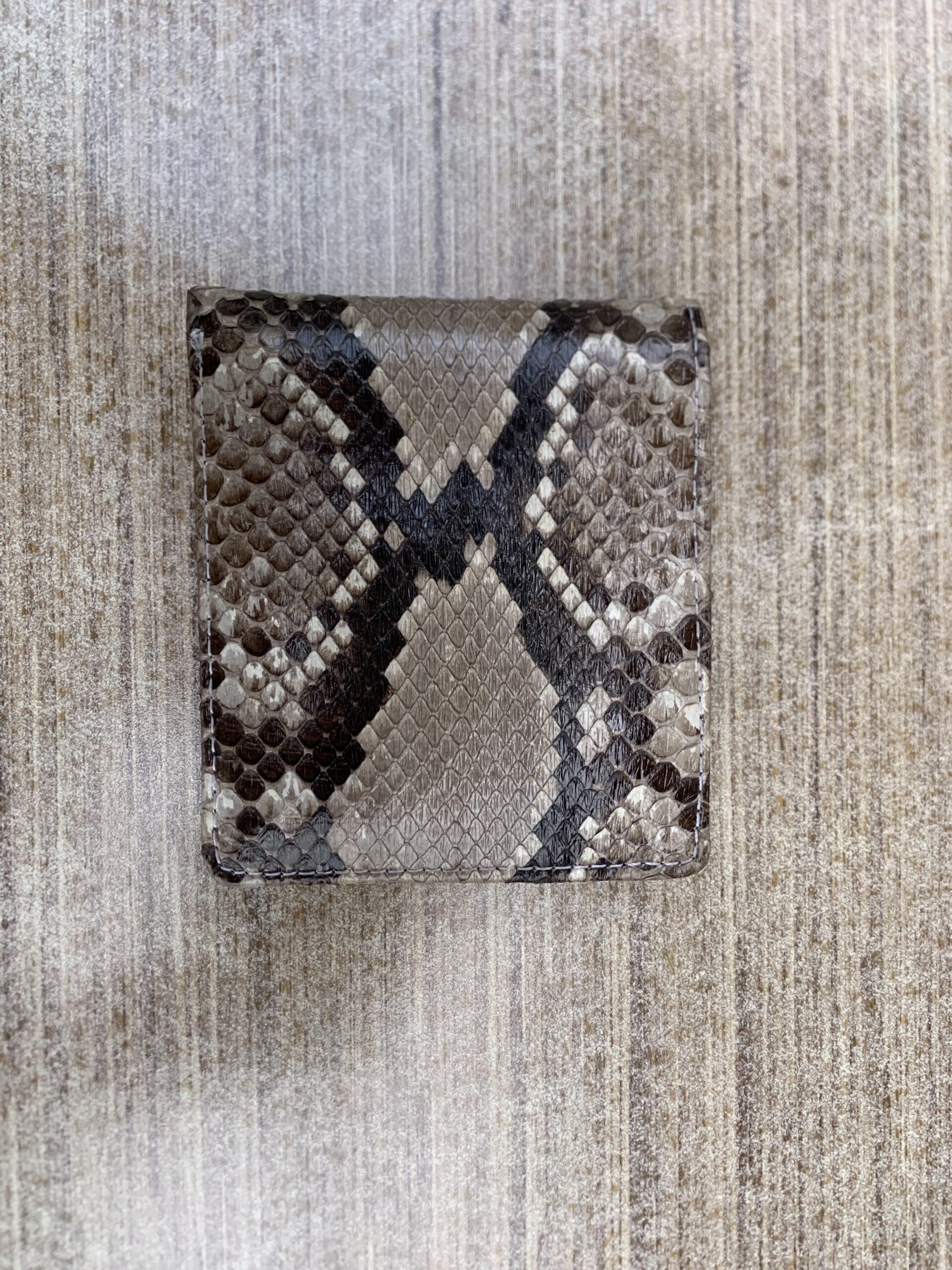
This wallet carries a natural black and grey scale pattern rather than the warmer tones I use elsewhere. It is a quieter palette, closer to charcoal than to anything decorative, and it suits an object that spends most of its life half-hidden in a pocket. A loud pattern competes for attention every time it comes out. This one simply does its job and looks sharp doing it, without asking to be noticed first.
Matching a pattern across a fold
The hardest part of this piece has nothing to do with the cutting. It is the matching. A bifold has to open and close along a crease, and if the panels are not aligned correctly before stitching, the scale pattern breaks at that fold instead of continuing through it. I select and align each panel by hand so the pattern reads as one surface across the whole wallet, not two separate pieces stitched together. Done right, closing the wallet should not interrupt the pattern. It should simply fold it.
What daily carry does to the surface
Every crease, every time it is opened and closed, every slide into a pocket leaves a trace eventually. Python skin is built to take that kind of handling well: the surface develops depth rather than damage, the fold lines settle in rather than cracking, and the overall piece reads as broken in rather than worn out. A wallet that still looks new after years of daily use usually means it was barely used at all. This one is meant to show its life.
A small option worth adding
This wallet can be finished with a short engraved message or a set of initials, up to forty characters, placed discreetly rather than across the main surface. I keep that option simple on purpose. The scale pattern is already the main event; an engraving here works best as a quiet, personal mark rather than another visual element competing for space. For a gift, it is often the detail that turns a well-made object into a specific one, made for a specific person.
Sourced and documented, not just sold
Python skin falls under international wildlife trade regulation, and I treat that seriously rather than as a footnote. Every panel used in this wallet comes from a regulated supplier, and export documentation is prepared for destinations where it is required. I would rather a buyer understand that process before checkout than discover it unexpectedly once the piece is already on its way.
Carrying it alongside everything else
A wallet spends most of its life next to a phone, keys, maybe a card case, so it has to sit well with whatever else someone carries daily without clashing against it. The darker, quieter scale pattern here is deliberately easy to pair with almost anything: a simple keychain, a watch, a piece with more presence elsewhere. It is built to be the steady, background piece in someone's daily carry rather than the one thing that has to coordinate with everything else.
Why bifold, and not something else
I keep coming back to the bifold shape for this material specifically because it puts the pattern to work rather than just displaying it. A money clip or a cardholder barely gives the scale pattern room to do anything interesting. A bifold opens and closes, flexes at a crease, and gets handled from more angles in a day than almost any other accessory. That motion is exactly where this material earns its keep: a flatter, more static shape would just be showing the pattern off. This one lets it move.
A quiet, consistent material choice
Attic Wild Side also makes a belt from this same python snakeskin, built on the same idea: a material that rewards close attention instead of demanding it from a distance. If you want to understand why this pattern behaves the way it does, our piece on the philosophy of python goes deeper into the material itself, or you can browse the complete Attic Wild Side collection for the rest of what we make with it.