
Before the first cut
The work does not start with a blade. It starts with a hide laid flat on the table and studied — turned over, held to the light, checked for the density and direction of the scale pattern. An experienced eye can tell in a few minutes where the strongest panel will come from, and which section should become the front of a wallet rather than the lining.
Reading the hide
Every hide has a natural layout: areas where the scales are tightest and most symmetrical, and areas better suited to smaller components like card slots or edge panels. Positioning the pattern pieces on the hide before cutting is its own quiet skill — done well, the finished object reads as one continuous surface rather than a patchwork of offcuts.
Cutting, skiving, and small disciplined movements
Once the layout is set, cutting begins — steady, deliberate strokes rather than fast ones. Edges are then skived, thinned along their border so that when two panels are folded and stitched together, the seam sits flat instead of bulky. This step alone can take longer than the cutting itself, and rushing it shows immediately in the finished piece.
Stitching by hand, edge by edge
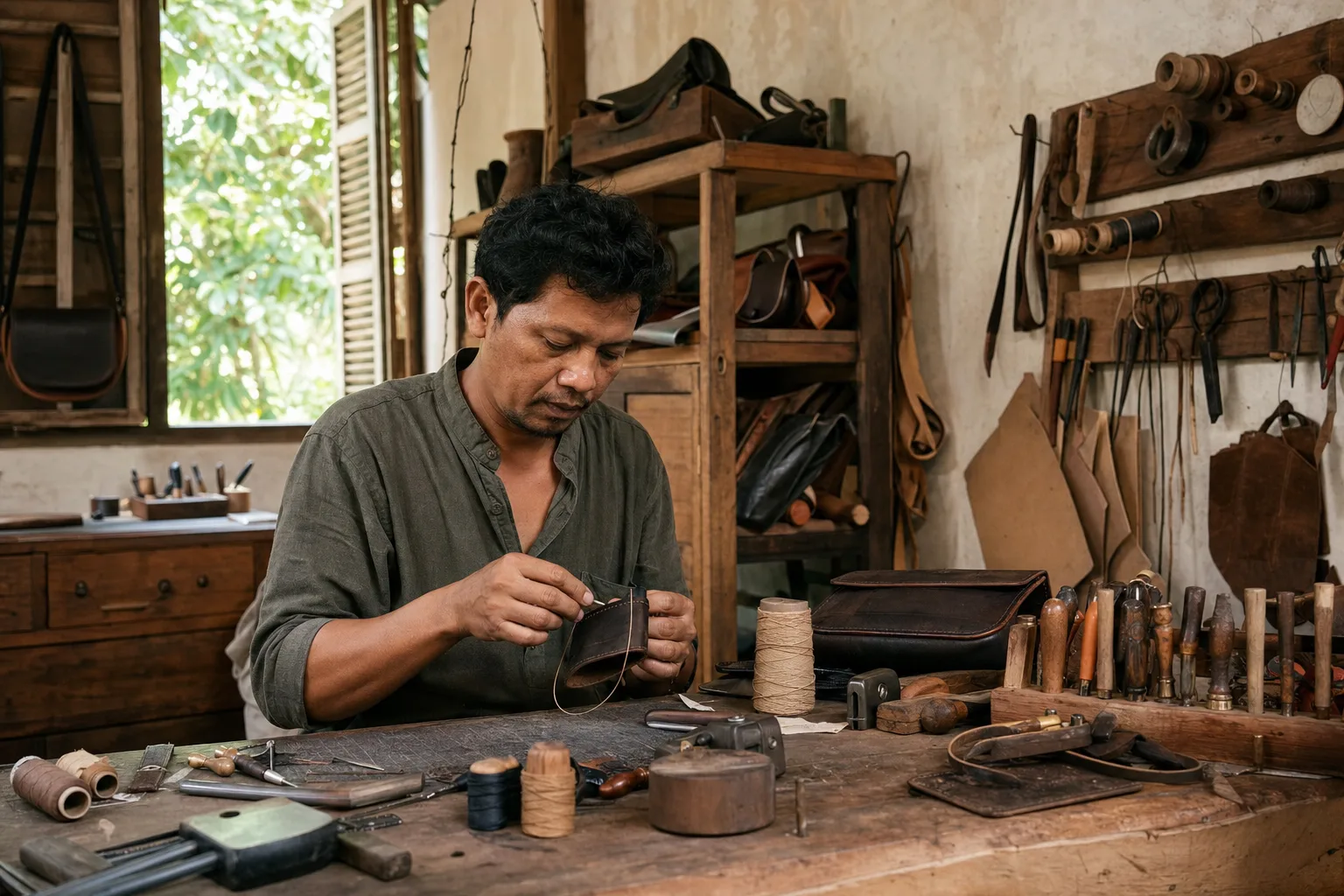
Hardware — buckles, rivets, clasps — is set by hand, checked, and reset if the alignment is even slightly off. Stitching follows, worked edge by edge rather than run through in one motion, with small adjustments made along the way as the material responds to the needle. It is guided by touch and feel far more than by a fixed template.
Why the pace can't be rushed
None of this moves quickly, and that is intentional. A slower rhythm is what gives handmade work its presence: the subtle decisions made at each stage — where a panel sits, how tight a stitch runs, how a corner is folded — remain visible in the finished object, even if you never consciously notice them.
What you're actually paying for
When you buy directly from our workshop, you are not paying for a brand mark stamped onto a mass-produced shell. You are paying for the accumulated judgement of everyone who touched the piece before it reached you — the person who chose the hide, the one who positioned the pattern, and the one who finished the final stitch by hand.