
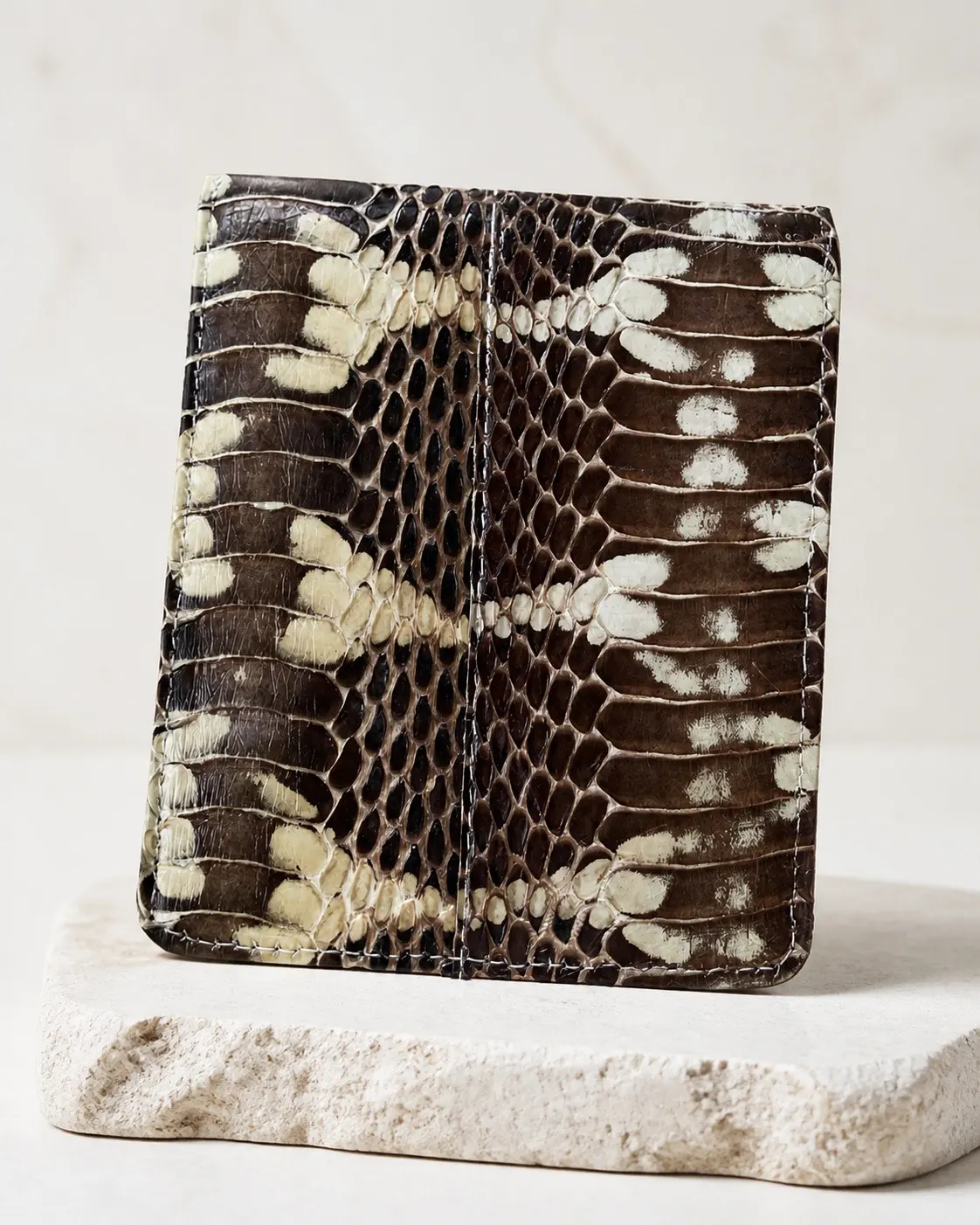
A handcrafted wallet begins with judgement, not a cutting machine. Before a pattern is placed, the material is inspected for scale direction, natural variation, strength, and the areas best suited to repeated daily use.
Reading the natural pattern
Cobra leather has a distinctive rhythm. The maker positions the wallet pattern so the scales remain balanced across the fold while avoiding weaker areas. This planning is one reason two finished wallets never look exactly alike.
Cutting, shaping, and reinforcing
The outer leather and supporting layers are cut separately, then shaped to create a slim bifold structure. Edges are thinned where layers meet so the finished wallet closes cleanly without unnecessary bulk.
Stitching and edge finishing
After the card sections are aligned, the piece is stitched and checked by hand. Edges are refined in stages, then polished so they feel smooth in the hand and remain comfortable in a pocket.
Final inspection and international preparation
Every finished piece is inspected for alignment, stitching, surface condition, and function. Applicable wildlife-derived materials are sourced through regulated suppliers, and our team prepares supporting export documentation where required for the destination.
No two scale patterns are identical. Natural variation is part of the object, not a manufacturing defect.
The result is a functional piece shaped by the material itself: made in Indonesia, intended for daily use, and designed to develop its own character over time.
Explore the current collection or read about CITES and sourcing support.