
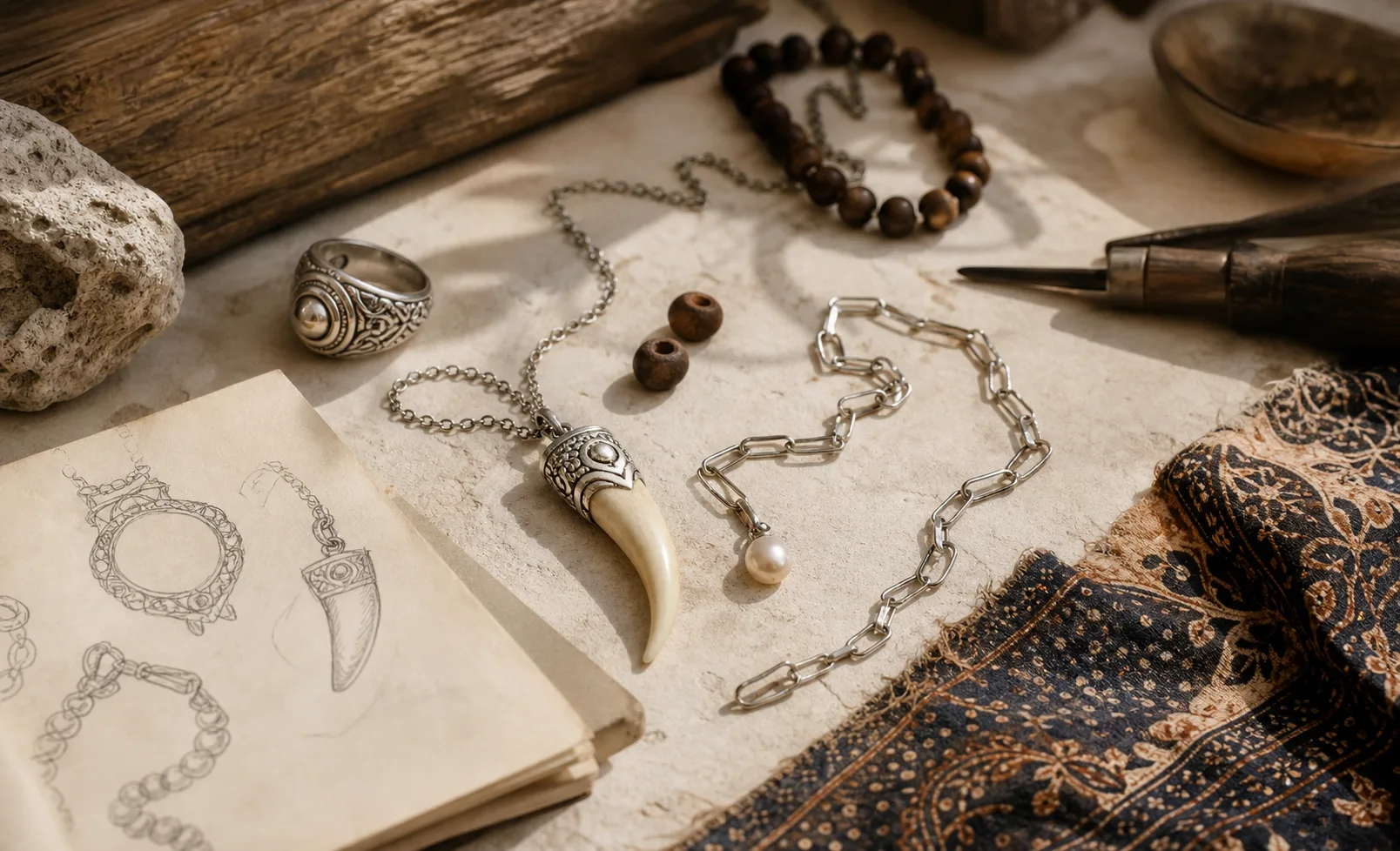
Handmade jewelry is strongest when it feels less like decoration and more like a small object with memory. A ring, necklace, bracelet, or pendant can be beautiful on the surface, but the pieces people keep for years usually carry something quieter: material, origin, symbolism, and the feeling that it was chosen with care.
Indonesian jewelry has a wide language of materials. Silver, pearl, wood, bone, tooth, shell, and natural forms appear across islands and craft traditions, each shaped by hand rather than made to look identical. For a buyer, this makes the choice more personal. You are not only choosing what looks good. You are choosing what kind of story the object should carry.
Start with meaning before material
Before comparing rings, necklaces, or bracelets, ask what the piece needs to say. Some jewelry feels protective. Some feels ceremonial. Some feels intimate and everyday. Some simply holds the beauty of a natural surface.
This is especially useful when buying a gift. A person who likes clean, symbolic jewelry may connect with a Balinese silver ring. Someone who keeps unusual objects close may prefer a natural pendant or a necklace with a stronger material story. A collector may care most about hand-finishing, irregular texture, or the fact that no two pieces can be repeated exactly.
Balinese silver: detail, patience, and guardian forms
Balinese silver work is known for its hand-finished detail. Carving, pattern, raised surfaces, and guardian-inspired forms can give a small ring or pendant a sense of presence without making it loud.
When choosing silver jewelry, look at the balance between symbol and wearability. A strong motif should still sit comfortably on the body. The best pieces feel intentional from every angle: the face, the side profile, the setting, and the way the silver catches light as it moves.
If you are drawn to protective or mythic forms, read our journal note on Barong in Balinese craft or browse the handmade Indonesian jewelry edit.
Pearl: quiet light rather than decoration
Pearl works differently from metal. It does not shout through shape. It carries light. A pearl detail can soften a silver piece, make a ring feel more personal, or turn a small object into something that feels almost ceremonial.
For everyday jewelry, choose pearl when the recipient likes restraint, softness, and natural imperfection. A freshwater pearl may not be perfectly uniform, and that is part of its appeal. The slight variation in surface and glow keeps the piece from feeling mechanical.
Natural pendants: texture close to the body
Natural pendants—whether tooth, wood, shell, or another organic material—often feel more talismanic than decorative. They sit close to the body and invite questions, but they do not need to explain themselves to everyone.
This is where material character matters. The curve of a tooth, the grain of wood, the tone of a bead, or the polish of a hand-finished surface can make the piece feel deeply individual. For some buyers, that individuality is the reason to choose it.
If you are considering this direction, our crocodile tooth necklace guide explains how natural-material jewelry can carry symbolism without becoming costume.
Bracelets and beads: rhythm, touch, and daily use
Bracelets and bead pieces are often chosen by touch as much as sight. They move with the wrist, collect small marks of wear, and become part of a daily rhythm.
Wood beads can feel grounded and warm. Silver can feel cooler and more formal. Mixed materials can make the piece easier to wear casually. When choosing a bracelet, think about the wearer’s habits: do they like something minimal, substantial, symbolic, or tactile?
How to choose jewelry as a gift
Jewelry is personal, so the safest choice is not always the most expensive one. The safest choice is the one that matches the person’s way of carrying meaning.
- Choose a ring if they like objects with a clear visual center.
- Choose a necklace if they prefer something close, private, and symbolic.
- Choose a bracelet if they like tactile everyday pieces.
- Choose pearl for softness and quiet light.
- Choose silver for detail, structure, and craft.
- Choose natural pendants for texture, origin, and talismanic presence.
If you are unsure, start with the recipient rather than the category. What do they already wear? What colors do they keep close? Do they prefer clean forms or visible texture? Do they like objects with a story, or pieces that disappear into daily life?
Why buying direct helps with jewelry
Buying direct from Attic Wild Side gives you a calmer way to compare pieces by material, use, and story. The website carries the complete collection, direct pricing, free worldwide shipping, and studio support before purchase.
This matters for jewelry because small details are important. You may want to ask about size, material, symbolism, current availability, or whether a piece feels better as a gift for a specific person. A short question before checkout can make the purchase feel more certain.
A final way to decide
If the person values symbolism, choose a piece with a clear form or story. If they value restraint, choose pearl or a quieter silver detail. If they value material character, choose natural texture. If they value daily use, choose something that can be worn without ceremony.
The best handmade Indonesian jewelry does not need to look perfect in a factory sense. It should feel alive in the hand, grounded in material, and personal enough that it could not have been chosen for just anyone.
Begin with handmade Indonesian jewelry, explore Balinese silver rings, or browse rare gifts for collectors if you are choosing for someone who already owns the obvious thing.