
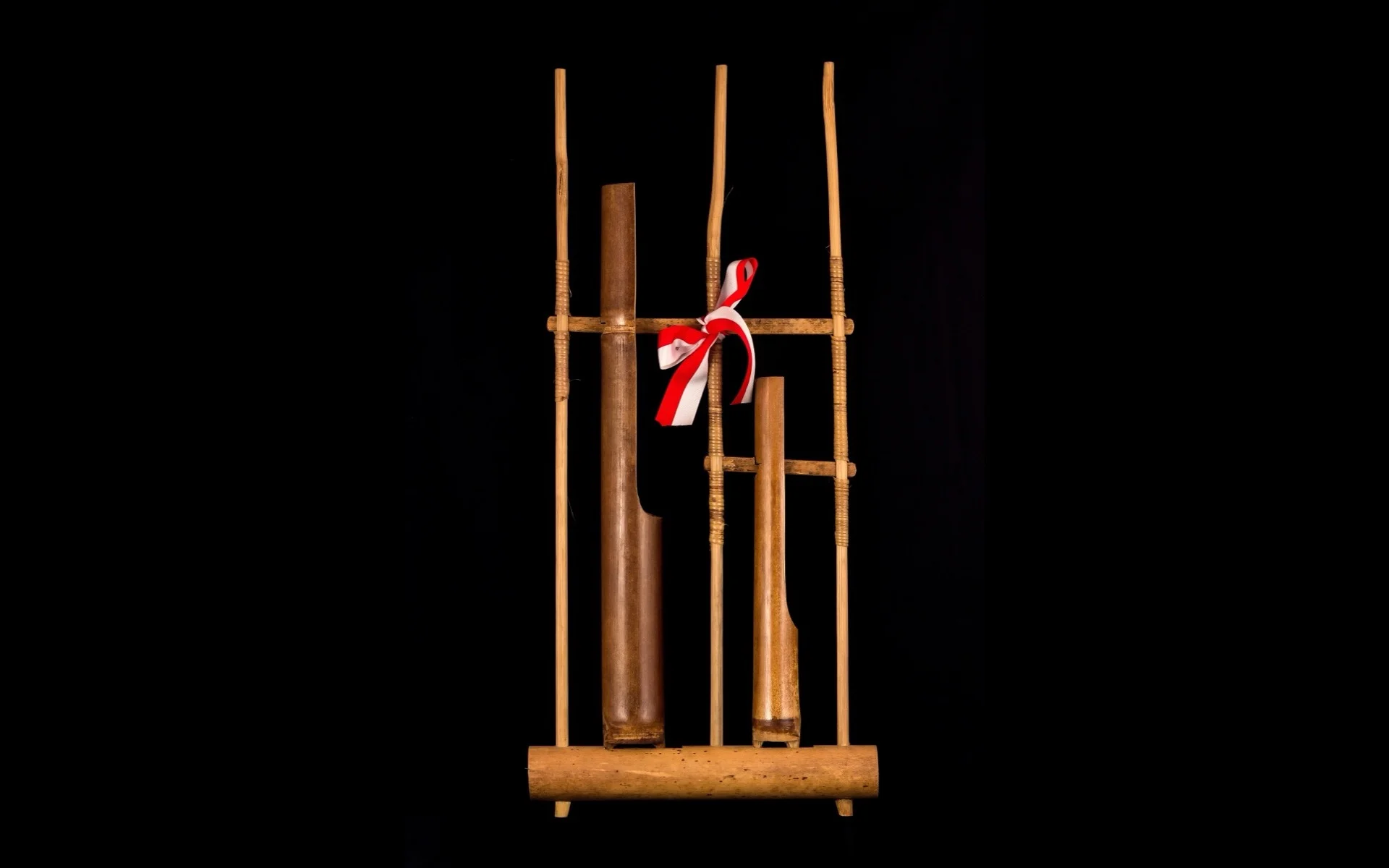
Few traditional instruments travel as far from their origin as the angklung has. Made from nothing more than cut and tuned bamboo tubes, it produces a sound immediately recognizable even to people who have never set foot in West Java, and it carries an official distinction that very few regional instruments anywhere in the world can claim: recognition by UNESCO as part of the Intangible Cultural Heritage of Humanity. That status did not come from novelty. It came from how deeply the instrument is tied to Sundanese life, and from a deliberate effort, decades ago, to make it relevant far beyond the rice fields where it began.
Grown from bamboo and rice-field tradition
The angklung''s roots sit in agrarian West Java, where Sundanese communities built a close relationship with rice cultivation long before the instrument became a concert object. In older tradition, its sound is associated with calling people together and with rituals connected to Dewi Sri, the rice goddess honored across much of West Java and Bali alike. The exact rituals varied by village and era, and most of what survives today is oral tradition rather than a single fixed record, but the underlying idea is consistent: bamboo, sound, and the rice harvest were never treated as separate things.
How one angklung makes one note
An angklung is built from two or more bamboo tubes of different lengths fixed into a bamboo frame, each tube cut and tuned to sound a single note when the frame is shaken. One player typically holds one angklung, which means one person contributes exactly one note to whatever is being performed. That design is simple to explain and genuinely difficult to master as a group, since the instrument gives a single musician no way to play a melody alone. Listening to an angklung by itself tells you almost nothing about what it is capable of. Listening to a full set played together tells you everything.
Daeng Soetigna and a wider range of music
For much of its history, the angklung was built around the traditional Sundanese pentatonic scale, which limited it mostly to older local repertoire. That changed in the 1930s and 1940s, when the Sundanese educator Daeng Soetigna is widely credited with developing a diatonic version of the instrument, tuned to the same scale used in Western music. The shift sounds technical, but its effect was significant: it meant angklung ensembles could suddenly play an enormous range of music beyond traditional songs, which opened the door to schools, orchestras, and eventually international stages adopting the instrument.
An instrument that only works together
Because each player holds only one note, an angklung ensemble cannot function as a collection of soloists. Every performance depends on timing, listening, and trust between players who individually control very little of the final sound. In Bandung, institutions such as Saung Angklung Udjo, founded by the musician and educator Udjo Ngalagena, built entire cultural centers around teaching this kind of ensemble play, turning the angklung into both a performance tradition and a hands-on lesson in cooperation. It is common to hear the instrument described in exactly those terms: proof that something complete can come from many incomplete parts, as long as everyone plays on time.
Recognized, not just preserved
In 2010, UNESCO formally recognized Indonesian angklung as part of the Intangible Cultural Heritage of Humanity, citing both the instrument itself and the educational, cooperative culture built around it. That recognition followed decades of angklung ensembles performing well beyond West Java, including international tours and cultural exchange programs that introduced the instrument to audiences with no prior connection to Sundanese tradition. Few regional instruments make that journey from village ritual to global stage while keeping their original form almost entirely intact.
Why collaborative craft matters
Attic Wild Side works in objects rather than performance, but the idea behind the angklung is one we recognize: a tradition that survives by adapting carefully, not by staying frozen or by losing what made it distinct in the first place. That is the same instinct behind the regional symbols and materials we work with across the collection.
If this kind of Sundanese cultural story interests you, our pieces on the kujang and Jaipongan cover two very different expressions of the same regional identity, or you can browse the complete Attic Wild Side collection for pieces that carry their own stories.